


After many years of relying on a draft guidance document regarding expectations around psychedelic drug research, the FDA has now released a finalized guidance document for clinicians and the health care industry at large. “Psychedelic Drugs: Considerations for Clinical Investigations,” released in July 2026, is a set of nonbinding recommendations covering classic psychedelics such as psilocybin and LSD, as well as entactogens such as MDMA. Much of it is addressed to sponsors and drug developers rather than directly to the clinicians who will sit with participants during a dosing session. I read it from the perspective that nearly every section describes a task that eventually lands on a trained human being in the treatment room. In this post, I’ll describe the implications for clinicians and sponsors as they pertain to training issues. The guidance is written for investigational stage drug development, and the practices it describes are the ones our field will carry into routine care once these treatments are approved. The clinicians who understand them now will be the ones prepared to deliver these therapies safely and credibly later.
Abuse potential is a question we have to answer, not assume
The FDA is clear that psychedelic drugs must be evaluated for abuse potential during treatment. It asks sponsors to document expected effects such as euphoria, hallucinations, and altered cognition as adverse events, even when participants do not describe them as adverse, and even when those effects are hypothesized to be part of the therapeutic response. It also calls for a systematic review of epidemiological data on how a drug is actually used outside of clinical settings.
Many people in our field hold that psychedelics are simply not addictive, and would rather move on from the question of abuse potential. What we have to remember is that the term psychedelics describes a diverse category of compounds, and providing those compounds in a treatment setting diverges significantly from many of the settings on which those assumptions are based. I come to this from the starting point of wanting future patients who receive psychedelic therapies in clinical settings to have the safest experience possible. My background is in addiction psychology, addiction studies, and addiction treatment, and that work teaches you to look at the global picture, including the social, psychological, and biological parameters that surround the actual experience of taking any drug. We must consider all of these factors when we think about addictive potential. Looking at addictive potential as a biopsychosocial product, including the person, the setting, and their biology, rather than a fixed property of a molecule, requires careful documentation of how people actually experience and respond to psychedelics in clinical research settings.
The responsible move is to find out what that profile looks like in practice, carefully and with real data, so that the people who receive these treatments in the future are protected by knowledge rather than by assumption. The FDA guidance is aligned with doing exactly that, and following it is a matter of safety for future recipients of psychedelic therapy. At Fluence, we train site teams to identify and document all central nervous system and psychoactive effects as adverse events, consistent with what the guidance asks.
Blinding and neutrality are training problems
The guidance devotes considerable attention to a problem this field has wrestled with for years: functional unblinding. It helps to distinguish functional unblinding from actual unblinding, a distinction we have drawn in our training programs. Actual unblinding occurs when a participant’s treatment arm assignment becomes known to them and/or the study team either due to breach in the blinding protocol, or because of a need to know a participant’s treatment status for the sake of a medical emergency. In this case, the treatment assignment is known because someone has accessed the randomization data, either by accident or by choice for the participant's safety. Functional unblinding is different. No one has seen the treatment arm assignment, and yet participants and observers form a strong impression of what dose was given based on the effects they experience or witness. When a drug produces intense perceptual changes or clear and immediate changes in symptoms, participants and their care providers often have a strong guess as to whether or not they received it.
The best practice is for all site staff to refrain from making treatment arm assumptions, and discourage participants from doing so as well. I believe the guidance is right to recommend central raters blinded to treatment allocation, blinding questionnaires that ask both participants and observers what they think was administered, and expectancy questionnaires that capture what people anticipated before treatment began. These tools matter. At the same time, we should not allow functional unblinding to be confused with actual unblinding. A strong guess belongs to a different category than a broken blind, and treating every accurate guess as a failure of the trial would misread what is happening in the room.
The training question follows directly from this. Our task is to train session monitors and all site staff to hold neutrality regardless of any guesses they may be tempted to make about a participant’s treatment condition. At Fluence we have built training materials on blinding and neutrality for session monitors and for site staff, because keeping a study unbiased belongs to everyone who interacts with a participant, not to the session monitor alone. A session monitor needs clear guidance on how to talk with a participant about the intensity of an experience without signaling what that intensity might mean about the dose received. Site staff need to offer the same tone regardless of what they suspect. And studies benefit from ongoing fidelity monitoring to confirm that session monitors are following that guidance rather than drifting from it over long months of enrollment. Neutrality is a skill, and like any skill it has to be taught, practiced, and checked.
Yes, we can have one monitor for dosing and another for integration
The FDA observes that the clinician who monitors the dosing session can usually infer their treatment assignment and that this knowledge could bias interactions delivered afterward. FDA recommendations include managing that bias by ensuring that the in-session monitor is not the same person who provides post-session follow-up visits. I read this as a way to mitigate the bias that could be introduced when a monitor does not hold neutrality, and it is a useful stopgap. What we are training people to do, though, is to avoid making that inference the basis of their behavior in the first place, and to act in the same way regardless of what they observed during the session.
This is also a meaningful structural choice. It asks programs to treat in-session monitoring and follow-up monitoring as distinct roles, each with its own relationship to the data. Fluence was built on a model of teaching therapists to provide integration services for people who take psychedelics in settings outside that clinician’s own office, so we are fully aligned with the idea of different clinicians stepping in to provide follow-up support and services. The guidance is candid that, as of its publication, the contribution of the supportive presence of a monitor to any observed benefit has not been characterized. The best way forward is to hold the support factor stable through training and ongoing consultation with session monitors as they work to respond to all participant experiences with the same defined set of supportive techniques.
Where this leaves us
The FDA guidance is nonbinding, the dosing paradigms are still being worked out, and the questions it raises about durability, repeat dosing, and long-term follow-up will take years of careful study to answer. As new research continues and post-approval programs are implemented, it will be essential to incorporate this guidance along with feedback from clinicians and patients regarding what is working well and what is not. I find that clarifying rather than discouraging. The document reads, to me, as a description of the workforce this field will need: people trained to document what they observe without flinching, to hold neutrality under pressure, and to differentiate between sitting with someone during a session and helping them integrate it afterward. That is the work we have been preparing clinicians to do and supporting drug sponsors to implement, and the guidance is a welcome sign that the standard we have been building toward is the one the field will be held to.
Thanks for reading,
Co-Founder & CEO

For the next four weeks, our Essentials of Psychedelic Therapy course is available at early bird pricing – $2,195, down from $2,500. This course gives clinicians and mental health professionals a solid, evidence-based foundation in psychedelic therapy: the clinical models, safety considerations, and therapeutic frameworks shaping the field today.
Hear more about our Essentials of Psychedelic Therapy course by watching this video.
Whether you're just starting to explore this work or looking to formalize your understanding before pursuing more advanced training, now's the time to enroll. This discount runs for four weeks only.
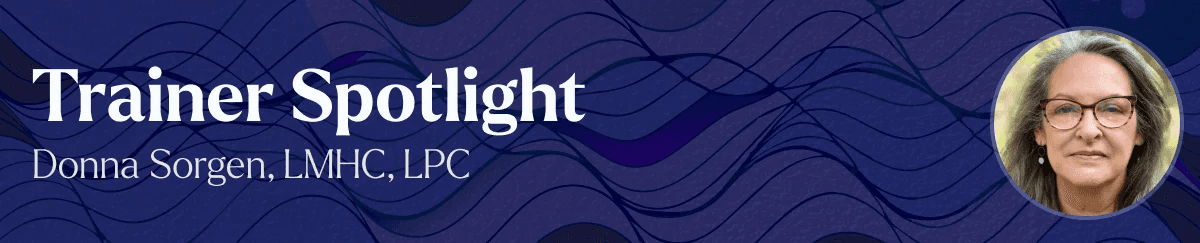
Donna Sorgen, LMHC,LPC (she/her) is a psychotherapist with over 25 years experience working with adults, children, adolescents, couples and groups. She is the Director/Owner of the Woodstock Therapy Center, a collective of practitioners providing a variety of services to the community including Ketamine Assistant Psychotherapy (KAP), psychiatric services, psychotherapy and holistic modalities. Donna has spent her career working with diverse clients in multiple settings.
Her current private practice includes KAP, Psychotherapy and Psychedelic integration therapy. Donna has completed training in MDMA-Assisted Psychotherapy for PTSD through the Multidisciplinary Association for Psychedelic Studies(MAPS). She was a sushi chef, caterer and enjoys the outdoors and gardening.

Curious about training in psychedelic therapy but unsure where to begin?
We’d love to help you gain clarity on how one of our courses fits into your path. Schedule a free 1-on-1 Zoom info call with Kabir Cooppan-Boyd, a Fluence team member dedicated to guiding you on your learning journey.
During your Zoom call, Kabir can answer your questions and explain how our courses connect to professional certificates in:
Ketamine-Assisted Psychotherapy
Psychedelic Harm Reduction & Integration Therapy
If you’re a clinician with questions or curiosity about our programs, this personalized conversation is the perfect way to find your best next step.
Schedule your free 1-on-1 Zoom call with Kabir

Start your journey now and move toward certification in Ketamine-Assisted Psychotherapy, or Psychedelic Harm Reduction and Integration at the current, lower rate.
All certificate programs start with our six-week Essentials of Psychedelic Therapy course, with the September cohort taught by Rebecca Love, LCSW and Donna Sorgen, LMHC, LPC.
Certificate Programs

Psychedelic Harm Reduction and Integration Therapy
September 10, 2026 - March 31, 2027

Ketamine-Assisted Psychotherapy
September 10, 2026 - April 13, 2027

All Fluence alumni who have taken a live-online course are eligible to join our 1200+ person Google Group. Members can work through protocol questions, share what they are seeing in the field, and get perspectives from colleagues doing the same work. If you have taken a live-online course but have not received your invite to the group, reach out here:
Email info@fluencetraining.com


FDA Finalizes Psychedelic Clinical Trial Guidance
The FDA issued final guidance addressing the "functional unblinding" problem that sank Lykos's 2024 MDMA-therapy application, codifying requirements like active placebos and expectancy controls, and set a public hearing on psychedelic therapeutics for September 14, 2026.

VA and HHS Sign Agreement to Expand Psychedelic Research for Veterans
The two agencies committed to boosting clinical trial access, training clinicians to administer psychedelics, and gathering data to support future regulatory decisions on treatments for veteran PTSD and related conditions.

Wall Street Sees a "Buy Signal" in Psychedelic Drugs
CNBC reports growing institutional and pharma interest in psychedelic mental-health treatments, as multiple candidates near FDA decisions and Big Pharma moves from the sidelines into the space.