

A team-built platform designed from real clinical training challenges to scale therapist training responsibly
As psychedelic therapy moves toward broader clinical adoption, one challenge stands out: there are far too few well-trained therapists to meet the need. Addressing that shortage responsibly will take more than enthusiasm for the field or excitement about technology. It requires training that is rigorous, ethical, scalable, and grounded in the realities of clinical care.
That is why we built Fluence Sync.
Sync did not begin as a tech concept looking for a use case. It grew out of years of running complex, multinational training programs for psychedelic therapy session monitors in clinical-stage drug development studies. For a long time, we managed those programs with a learning management system, spreadsheets, and a team whose skill and dedication often compensated for the limitations of our tools. We made it work, but only through constant human effort. Over time, it became clear that the model was too fragile to support the scale and consistency the field will require.
We were tracking enrollments, progress, assessments, role-plays, readiness decisions, trainer notes, and documentation across disconnected systems. We lacked a true single source of truth for training data. Clients had no simple way to view real-time program information. Trainers lacked a centralized portal that clearly showed what needed attention next. The operational burden was real, and so were the risks to clarity, efficiency, and oversight.
What made this especially important is that psychedelic therapy training cannot be reduced to a checklist. Training has to preserve nuance. It has to support ethics, judgment, attunement, adherence to protocol, and the ability to respond skillfully in complex human situations. That kind of development requires practice, feedback, individualized evaluation, and sustained support. When you are doing this across clinicians with different backgrounds, time zones, languages, and site realities, you are not simply running a program. You are creating the quality of future care.
The design principle of form follows function captures our approach to building technology to support our programs.
In art and design, form follows function means that the shape of something should be determined by what it actually needs to do. We took that seriously. We did not want to force clinical training into a generic software mold, and we did not want to decorate operational problems with a sleek interface and call it innovation. We wanted the platform’s structure to emerge from the real demands of the work itself.
That meant starting with function.
Long before Sync existed as software, our team had already built the logic of the platform by hand. We had developed workflows for competency decisions, systems for tracking readiness, methods for trainer triage, and clear distinctions around what different stakeholders needed to see. In effect, we had already designed the function. The form came later. Sync was built by translating that lived, field-tested operational knowledge into product.
That is also why this is fundamentally a team-built product.
My own perspective as a psychedelic clinical trials therapist, trainer, site co-PI, and researcher shaped the vision for what the system needed to protect. But the product itself came from a team living these challenges every day. Our trainers and staff defined what meaningful practice requires. They refined the content, operationalized the rubrics, improved the workflows, and carried the daily responsibility of helping clinicians develop real skill. Sync reflects that collective intelligence. It is the result of a team translating real-world experience into infrastructure.
That translation required strong engineering leadership, and Bapusaheb Patil (a.k.a. Baps), our Head of AI & Design Engineering, was central to making it happen. Baps played a key role in converting complex operational workflows into technical architecture, identifying practical solutions, and building a roadmap that matched both our ambitions and our resources. Just as importantly, Baps understood that the system had to support a deeply human process without flattening its complexity. That understanding shaped how the product was built from the start. Within months, we were onboarding our first clients to the first version of Sync.
Baps’s contribution matters not only because of execution, but because the execution was disciplined. The platform was not designed around hype. It was designed around function: what trainers need to see, what trainees need to practice, what clients need to understand, and what administrators need to manage. That is what made it possible to build something coherent, useful, and durable.
The same principle guides how we use AI.
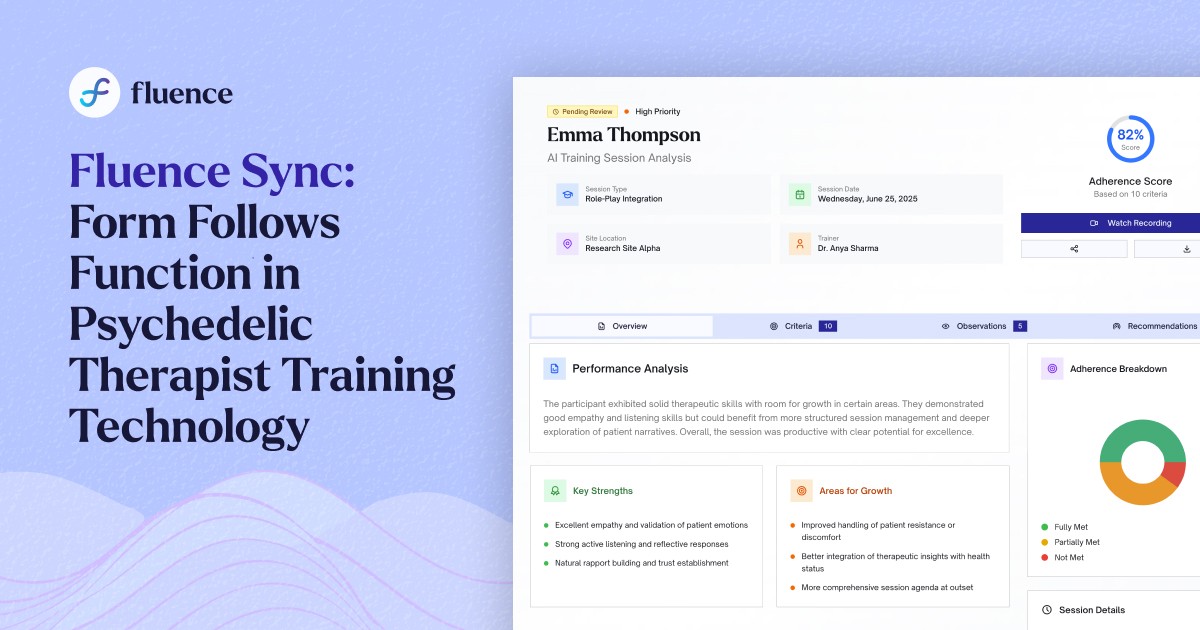
Much of the conversation around AI in mental health and clinician education centers on simulation, replacement, or generating ideal responses. That is not our approach. At Fluence, trainees complete role-plays based on specific scenarios and criteria. Our proprietary AI-assisted analysis system–which I’ll share more about in a future post–analyzes transcripts from those practice sessions and produces structured feedback aligned to the training rubric. That helps trainees improve more efficiently and helps trainers focus their time where human judgment matters most.
But AI output alone is not a training system. It only becomes useful when it is placed inside the right structure. That is part of what Sync does. It brings together AI-generated role-play analysis, trainer feedback, progress tracking, reporting, notifications, and stakeholder visibility in one secure platform with multi-tenancy and role-based access control. In that sense, form follows function here too: the technology is shaped around the needs of a real training process, not the other way around.
Sync is a purpose-built platform for managing and improving clinical training in psychedelic therapy and related emerging fields. The AI reports are one component of a broader human system of learning, oversight, and continuous improvement. Trainer review remains essential. Human feedback remains essential. That is what responsible technology looks like in this context: extending the reach of skilled people without compromising quality.
This matters because the shortage of trained psychedelic therapists is real, and solving it responsibly will require better systems, not shortcuts. We need ways to expand training capacity while preserving rigor, ethics, and human depth. We need infrastructure that supports scale without turning training into something thin or mechanical.
That is what Sync was built to do.
Today, Sync gives us a true single source of truth for training data. It gives clients better visibility into program status. It gives trainers a dedicated portal that makes action clear. It transforms labor-intensive manual processes into digital workflows that preserve training integrity, data quality, and operational oversight. Most importantly, it frees human attention for the work that actually requires human presence. When trainers spend less time chasing fragmented information, they can spend more time helping clinicians grow. When workflows are coherent, quality becomes easier to sustain at scale.
For us, this is the larger commitment behind Fluence Sync: to bring technology into service of high-quality psychedelic therapy training thoughtfully, responsibly, and at scale. The platform was shaped by real clinical demands, built by a team with lived expertise, and strengthened by engineering that respected the function of the work. In the best design sense, its form follows its function. And its function is to help expand the workforce of well-trained psychedelic therapists without losing sight of what this work asks of human beings.